Photograph the work.
How a picture of a mat becomes a position on the field — in four steps, none of them magic.
- 1
Photograph the work.
The mat and the material, never the child. A guide takes one picture of the work as it stands — the observation they already make, kept without the notebook.
- 2
The material's own control of error reads it.
Each material carries its criterion inside the object: the cylinder that will not fit, the cube left over, the piece that only goes one way. The reading asks that question and no other — there is no rubric and no assessor.
- 3
That becomes a position on the four dimensions.
Work that satisfied its own criterion places the child on the field: which qualities their work has covered, how far into the stated order it reaches, how far toward the symbol. A region, never a score.
- 4
The field shows what opens next.
What the constraints admit from where the child is, each step carrying the sentence that opens it. Where the books state a sequence, the sequence is shown. Where they are silent, the branch is shown as a branch.
Each material isolates one quality and shows its own error — that is how a photograph becomes a position.
Those two things are features: inputs the mechanism reads. The kind of control of error a material carries, whether that kind is legible in a still at all, the quality it isolates, the strand it belongs to — the system reads them here, on this page, and they stay here. What is measured is the four dimensions: Abstraction, Difficulty, The senses and Readiness.
Two of the eight kinds of control of error reach no camera — a rough-and-smooth board and a set of sound boxes are read by hand and by ear. That boundary is named as scope rather than hidden, and that work goes to the guide.
Try it on one mat
demonstrationThe four steps above, on a single piece of work. The recognition step is a demonstration — these mats are drawn, not photographed, and no model read them. What the recognition is placed onto is real: every step below the hatched card is a sentence from a public-domain book, shown with the page it sits on.
Placement here is position on the progression as currently witnessed — one lineage’s view of order, shown with every witness that asserts each hop. When the composed field exists, placement becomes a position and a gradient over the whole catalogue and supersedes this view. The field is not composed yet, and this page does not pretend otherwise.
Observation
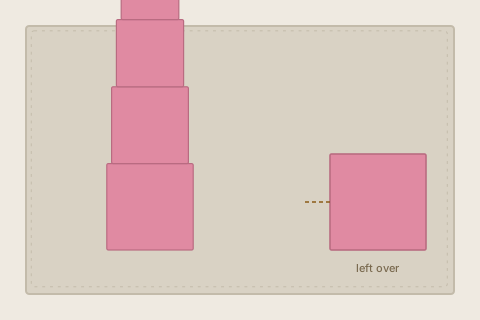
Staged vector rendering. Mat and material only — no child, no face, no hand.
What the material shows
next best: the-broad-stair 4%
- observed
- Nine cubes stacked in descending order; the largest cube is on the mat, unplaced.
- expected
- The series is complete only when every cube is placed, smallest last.
The work shows its own error. There is no place left for the largest cube — the material said so, not an adult.
What is known about this material
derivedRead from the books twice, independently, and shown here beside the work. Nothing here is about the child — these are properties of the material on the mat.
after Solid Insets, Dressing Frames, Plane Geometric Insets · before Long Stair, Broad Stair
step 1 of one admissible embedding of the partial order
dimension
The control of error, in the book’s words
extractedThe reading above was made against this. It is not a rubric written for the purpose — it is what the witness says the material itself does when the child is wrong.
“They begin it with the next biggest, and, when they have finished, find that they cannot place the largest one without tearing down the whole structure.”
“But in these games the eye easily recognises a mistake, and the teacher assists the child to detect errors by showing him how to pass his hand lightly up and down the steps of the Tower and Big Stair, or along the sides of the Long Stair.”
When the book says this work is taken up
“In Italy children two years old are often seen in the Casa dei Bambini using the tower, prisms, and the frames.”
Position on the progression, as currently witnessed
extractedThe canonical progression, computed from every deposed witness. Lit: the work recognised above, with the steps some witness puts before and after it. Every hop below resolves to a sentence and the leaf it sits on. This is where the work sits in the order the books attest — not a field placement, which arrives only when the field is composed.
Line weight = witnesses asserting the ordering. Dashed = one reading arm asserted and the other, on the same pages, did not.
Comes before (3)
Dressing Frames → Pink Tower1 of 3 witnesses
“After the child has had a day or so of practice with the Geometric Insets and Buttoning Frames, allowing him to take them up and lay them down at will, it is time to bring out the blocks composing the Tower.”
Plane Geometric Insets → Pink Tower1 of 3 witnesses
“After the child has had a day or so of practice with the Geometric Insets and Buttoning Frames, allowing him to take them up and lay them down at will, it is time to bring out the blocks composing the Tower.”
Solid Insets → Pink Tower1 of 3 witnesses
“Let us look at the three sets of material which are presented after the exercises with the solid insets, i.e., the material for teaching size (the pink cubes), thickness (the brown prisms), and length (the green rods).”
Comes after (2)
Pink Tower → Long Stair1 of 3 witnesses
“After the Tower and the Stair comes the third set of blocks, or rods, called the Long Stair.”
Pink Tower → Broad Stair1 of 3 witnessesone arm only
“After the Tower, the next exer- cise is the Broad Stair.”
Recognition is a fixture in site/fixtures/recognise.json, shaped as the future API response. Placement is not a fixture — it is computed from the extraction artefacts each time this page renders. See site/README.md for the contract.